


Buying a commercial laundry machine for sale is one of the biggest investments you’ll make for your business or facility. The options are overwhelming-from online marketplaces to used equipment dealers-and the costs vary dramatically.
At Oasis Laundry, we know that choosing the right equipment means balancing capacity, efficiency, and budget. This guide walks you through exactly where to shop, what features matter most, and how to avoid overspending.
Where to Buy Commercial Laundry Machines
Online Marketplaces and Retailers
Online marketplaces like eBay and Facebook Marketplace offer convenience and sometimes lower prices, but they come with serious trade-offs. You’ll have no local support when something breaks, and you can’t inspect equipment before purchase. Shipping costs add up quickly for heavy machinery, and you’re stuck dealing with the seller directly if problems arise after delivery. These platforms work best for small, non-critical equipment purchases, not for your primary commercial washers or dryers.
Direct Manufacturer Sales
Brands like Speed Queen and Huebsch sell directly to businesses and provide access to financing programs and official warranties. You get locked into their product line, however, which limits your flexibility if you need different capacity or features. Direct sales also mean you handle installation and service coordination yourself, adding complexity to your operation. The upside is clear pricing and manufacturer-backed support, but you lose the advantage of working with a supplier who stocks multiple brands.
Used Equipment Dealers and Full-Service Providers
Used equipment dealers and auctions provide significant upfront savings, but replacement parts become harder to find and repair costs spike unexpectedly. The smartest approach is finding a full-service provider in your region who stocks multiple brands and offers sales, installation, maintenance, and parts all in one place. This reduces downtime dramatically because you’re not coordinating with separate vendors when something fails.
Providers with multiple warehouse locations can deliver spare parts quickly and send trained technicians within hours rather than days. Ask potential suppliers directly: Where are your nearest warehouses? How quickly can you deliver parts? What’s your average response time for service calls?
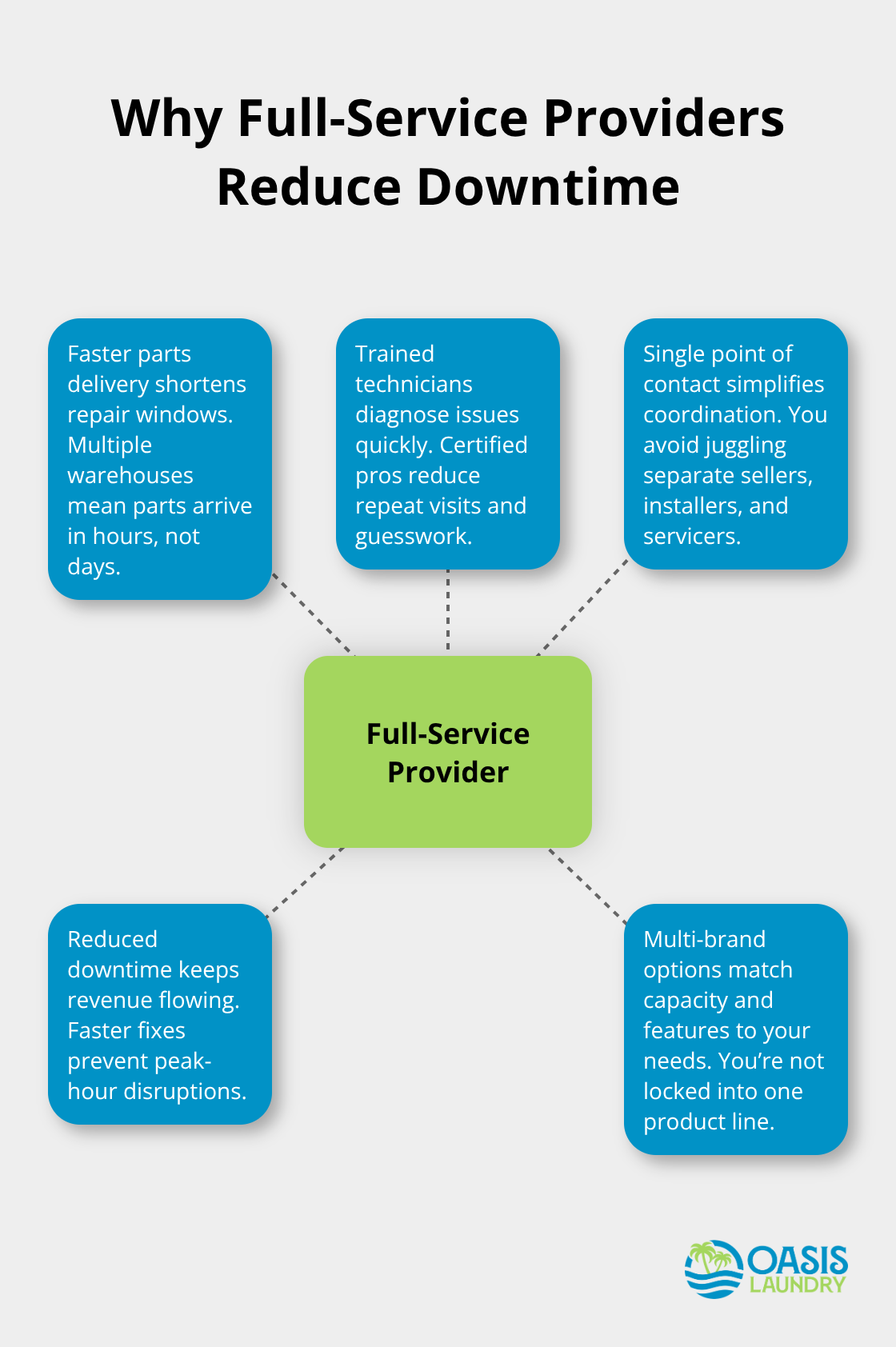
These answers separate reliable partners from suppliers who’ll leave you scrambling when a machine goes down during peak business hours. A provider who handles everything in-house eliminates the frustration of juggling multiple contacts and waiting days for repairs.
Making Your Selection
The choice between these options depends on your operation’s size and your tolerance for downtime. Small businesses with tight budgets might accept the risks of online purchases or used equipment. Larger operations that depend on continuous laundry service need the reliability and speed that full-service providers deliver. Your next step is evaluating what specific features and capacity your facility actually requires.
What Specifications Actually Matter for Your Operation
Measure Your Laundry Volume and Space Accurately
Start by measuring your laundry volume in pounds per week, not just guessing. A hotel generating 2,000 pounds of linens daily needs vastly different equipment than a small gym producing 300 pounds weekly. Capacity mismatch is the most common mistake-businesses either oversize and waste money on machines that run half-empty, or undersize and create bottlenecks that force staff to run extra cycles. Measure your space precisely too. A commercial washer needs clearance on all sides for hose connections, drainage access, and technician repairs. If your space is 6 feet wide, a 5-foot-wide machine leaves almost no room to work.
Visit potential suppliers and see machines in person, not just in photos. You’ll immediately understand whether the footprint fits your layout and whether you can actually access the connection points.
Energy and Water Efficiency Cuts Your Operating Costs
Energy and water efficiency directly impact your bottom line every single day. Newer commercial machines use an average of just 15 to 25 gallons per cycle, compared to older models that used 40 to 50 gallons per cycle. If you run 50 loads weekly, that difference translates to thousands of gallons saved annually and measurable reductions in your utility bills.
Girbau machines emphasize energy efficiency and environmentally friendly designs with advanced control systems, making them solid for sustainability-focused businesses. LG combines advanced technology like TurboWash with energy efficiency, though with higher upfront costs. Look at the machine’s specifications for gallons per cycle and kilowatt-hours per load-these numbers compound over the machine’s 10 to 15-year lifespan.
Durability and Warranty Protection Matter Most
Durability and warranty coverage matter because cheap equipment that breaks repeatedly destroys any savings from lower purchase price. Dexter Laundry is renowned for robust construction and reliability in high-volume operations. Maytag offers durable engineering with strong warranty and service options. Whirlpool stands out for durability and extensive service networks.
Ask suppliers directly about parts availability and average repair costs for models you’re considering. A machine with expensive replacement parts or hard-to-find components will drain your maintenance budget quickly. The brands you select should have parts warehouses within reasonable distance from your facility, ensuring technicians can access components without long delays.
Next, You’ll Need to Understand Your Financing Options
Once you’ve identified the specifications that match your operation, the financial side of the purchase becomes your focus. Whether you buy new or used equipment, lease or purchase outright, and how you structure the deal will shape your business’s cash flow for years to come.
Should You Buy or Used Equipment
New commercial laundry equipment costs significantly more upfront but delivers measurable returns through reliability and efficiency. New commercial laundry equipment cycles before major repairs vary by machine type: topload washers last 5-8 years, frontload washers 10-15 years, and dryers 10-15 years. New machines also include manufacturer warranties covering defects for 1 to 3 years, protecting you from unexpected repair bills during the critical early ownership period. Used equipment rarely comes with transferable warranties, leaving you exposed to expensive failures immediately after purchase.
Energy Savings Recover Your Investment Quickly
Energy consumption differences between new and older laundry machines are substantial. Modern equipment can cut water consumption by 50-85% compared to older models, which means a facility running 50 loads weekly saves thousands annually on water and utilities. Parts availability matters enormously.

Replacement components for machines manufactured within the last 5 years stock at regional warehouses and arrive within days, while older equipment requires searching salvage yards or waiting weeks for specialty parts.
Financing also favors new purchases. Huebsch offers financing up to 70 percent of equipment cost with fixed rates as low as 5.75 percent for the first 12 months and terms extending up to 120 months for larger deals, making new equipment affordable without massive cash outlay. Used equipment costs less initially but forces you into a calculation: Will savings on the purchase price offset higher repair costs, longer downtime, and the constant risk of catastrophic failure? Most facilities discover that used equipment becomes expensive quickly once you account for technician visits and replacement parts.
Leasing Transfers Maintenance Responsibility to Your Provider
Leasing commercial laundry equipment transfers maintenance responsibility to the provider and guarantees access to newer machines without capital expenditure. Route leasing, common in the coin-operated laundromat industry, lets you avoid equipment ownership entirely while paying a percentage of revenue to the lessor. All-inclusive leasing covers installation, maintenance, parts, and service for a fixed monthly fee, eliminating surprise repair costs.
This approach works best for startups or facilities uncertain about long-term laundry volume because you can adjust capacity as your business grows. The downside is that total leasing costs over 5 to 10 years typically exceed purchasing outright, and you never build equity in the equipment. Full-service providers in your region often offer leasing alongside purchase options, giving you flexibility to test equipment before committing to ownership. Ask potential lessors about buyout options at lease end-some programs let you purchase equipment at reduced rates if you decide ownership makes sense after the initial term.
Hidden Expenses Drain Budgets Faster Than Expected
Maintenance costs beyond repair bills drain budgets faster than most business owners expect. A commercial washer requires monthly hose inspections, quarterly seal replacements, and annual deep cleaning of internal components-costs typically running 500 to 1,500 dollars annually depending on usage intensity. Drain line blockages from lint and detergent residue create expensive emergency repairs if not addressed through preventive maintenance.
Water softening systems add 200 to 400 dollars annually to keep mineral deposits from damaging internal mechanisms. Chemical costs for detergent and fabric softener vary by machine capacity but often total 3,000 to 8,000 dollars yearly for high-volume operations. Utilities represent the largest hidden expense-electricity and water for 50 weekly loads can exceed 300 dollars monthly on older equipment. New machines reduce this to 150 to 200 dollars monthly, recovering the efficiency premium within 3 to 5 years.

Service contracts with full-service providers typically cost 50 to 100 dollars monthly and cover emergency repairs, preventing the catastrophic 5,000 to 10,000 dollar breakdowns that shut down operations for days. Requesting a total cost of ownership projection from your supplier forces them to account for these expenses and prevents surprises later.
Final Thoughts
Buying a commercial laundry machine for sale requires you to balance five core factors: your actual laundry volume, available space, energy efficiency gains, warranty protection, and total cost of ownership over the machine’s lifespan. Most business owners focus only on purchase price and regret it within two years when repair bills and utility costs mount. The facilities that make smart decisions measure their needs precisely, compare total expenses across new and used options, and prioritize working with providers who offer ongoing support.
Your next step after selecting equipment involves confirming installation timelines and service response guarantees with your chosen supplier. Ask whether they handle connection to your existing drainage and water lines, test the machine before leaving your site, and train your staff on operation. Request a written service agreement specifying response times for emergency repairs and what coverage the warranty provides.
Quality equipment delivers measurable returns that compound over years-a new commercial washer cutting water usage from 40 gallons per cycle to 20 gallons saves roughly 1,000 gallons weekly for a facility running 50 loads. Machines built for durability with accessible parts and strong warranties eliminate the constant anxiety of unexpected breakdowns during peak business hours. At Oasis Laundry, we understand that reliable equipment matters for your business success, and we offer tailored services for linens and uniforms with guaranteed quality and timely delivery. Visit Oasis Laundry to explore how we can support your laundry needs.