

Picking the right commercial laundry dryer makes a real difference in your operation’s efficiency and bottom line. The wrong choice can drain your budget through high energy costs and frequent repairs, while the right one pays for itself through reliability and performance.
We at Oasis Laundry have helped countless business owners navigate this decision. This guide walks you through the features, technologies, and costs that matter most so you can match a dryer to your actual needs.
Key Features to Look for in Commercial Laundry Dryers
Capacity and Speed Drive Your Throughput
Capacity and drying speed directly impact your throughput and profitability. Most commercial operations fail because they either undersize their dryers, creating bottlenecks that frustrate customers, or oversize them, wasting energy on loads that don’t fill the drum. Size your dryers at 1.25 to 1.5 times your washer capacity. If you run high-extraction washers that remove more water upfront, plan for 1.2 to 1.5 times the washer size since your loads arrive drier. A hotel processing 100 pounds of laundry daily needs dryers totaling 125 to 150 pounds of capacity spread across multiple units.
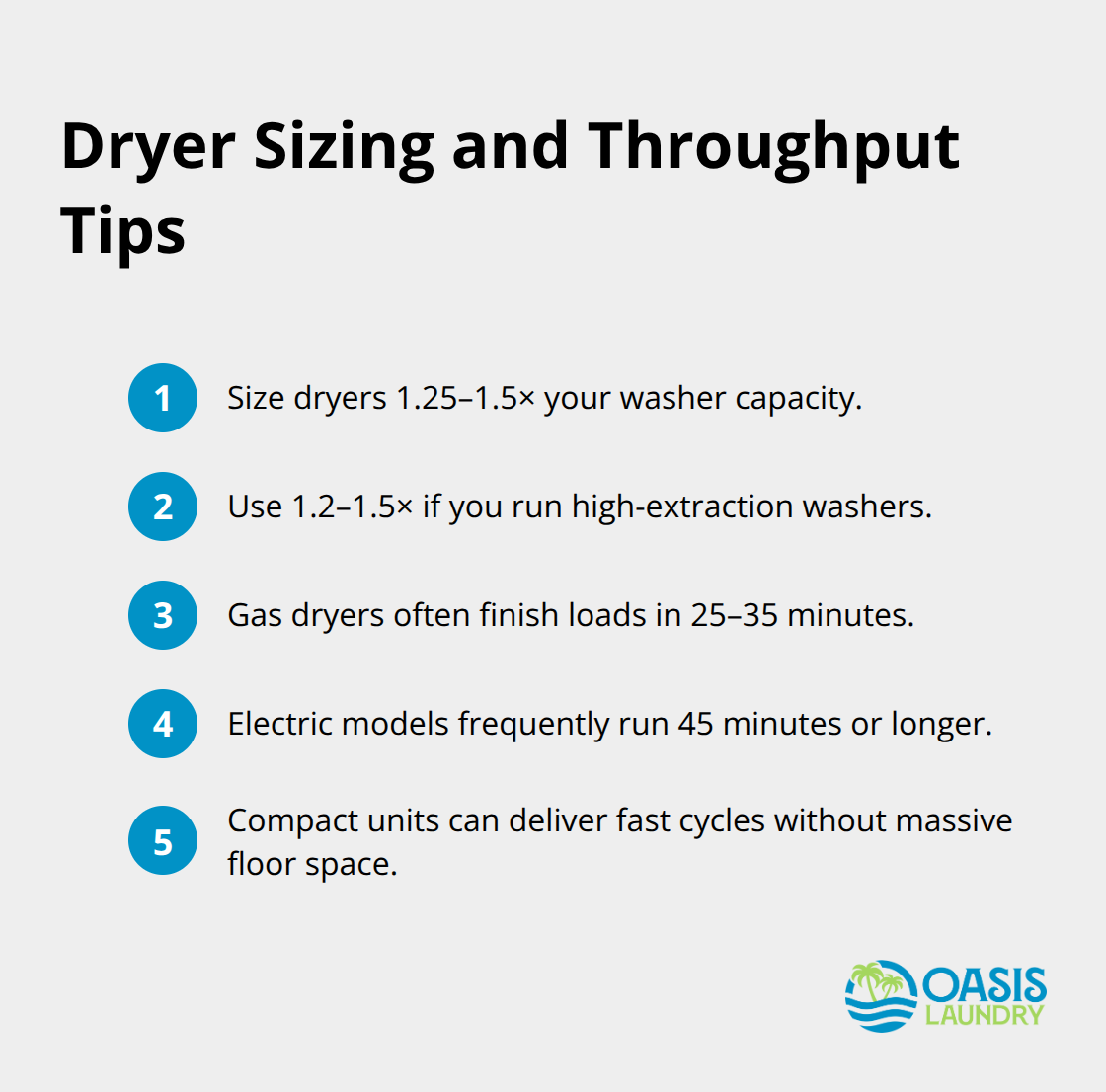
Gas dryers typically complete cycles in 25 to 35 minutes, while electric models often run 45 minutes or longer. This speed difference matters enormously in high-volume settings. A gas dryer processes roughly double the loads per day compared to an electric unit in the same timeframe. Some commercial gas dryers now complete full cycles in under 45 minutes, which keeps lines moving during peak periods. Compact models deliver fast cycles without requiring massive floor space.
Energy Efficiency Ratings Reduce Operating Costs
Energy Star certification directly reduces your operating costs rather than serving as a green marketing label. According to Alliance Laundry Systems Distribution, utilities account for 60 to 70 percent of total operating costs in commercial laundry operations. An Energy Star certified dryer saves approximately $900 to $2,400 annually depending on the model and usage patterns. UniMac dryers report up to 30 percent energy usage reduction compared to standard models.
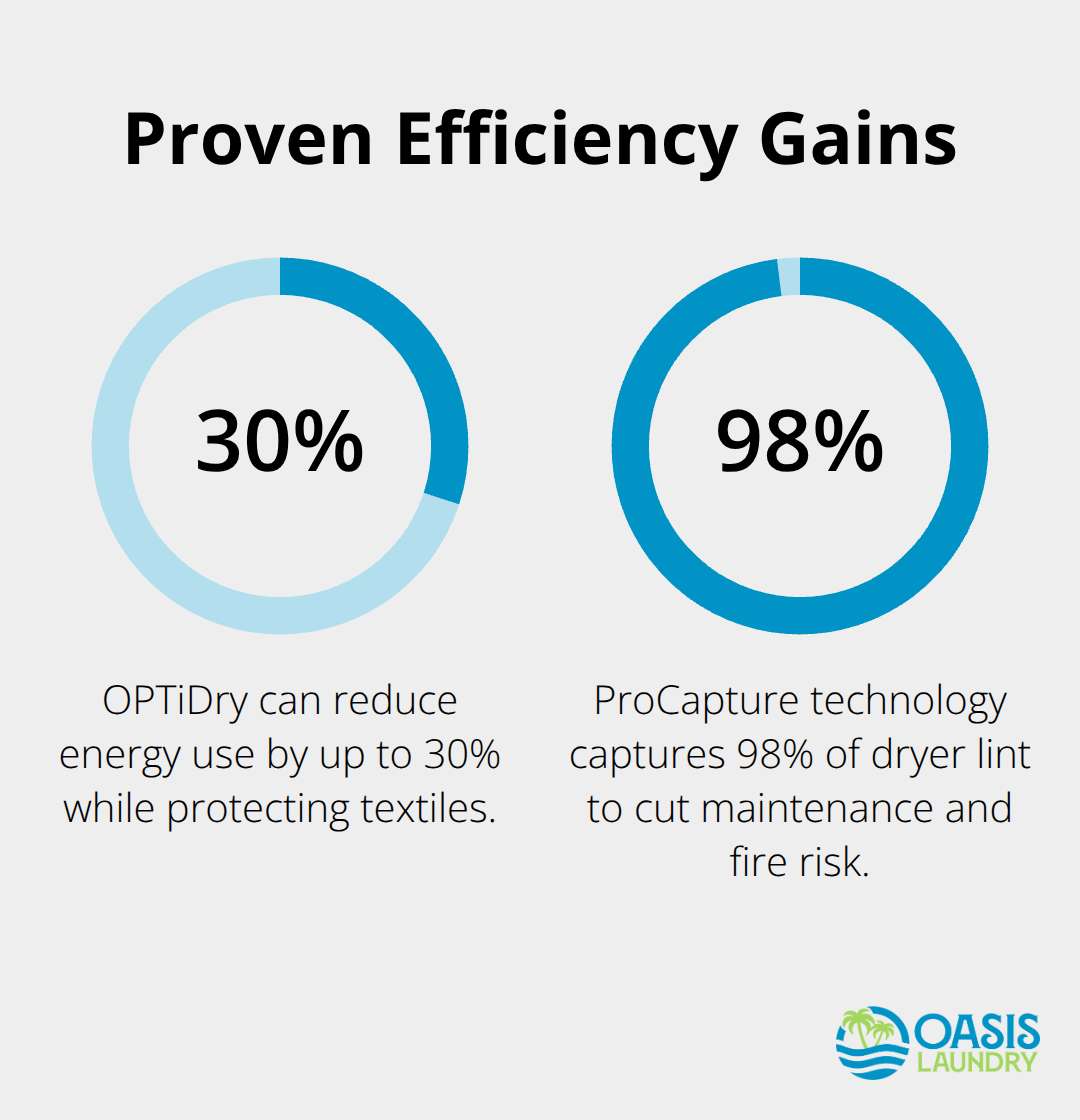
Moisture-sensing technology stops the cycle early when clothes reach the target dryness level, preventing unnecessary energy waste and protecting fabrics from over-drying damage. Heat recovery systems and variable-speed drives further reduce consumption. ProCapture lint removal technology captures 98 percent of dryer lint according to Alliance Laundry Systems Distribution, which reduces vent blockages, cuts maintenance costs, and lowers fire risk. When comparing purchase prices, factor in these long-term savings. A dryer costing $500 more upfront but saving $2,000 annually in utilities pays for itself in three months. Many utility companies offer rebates between $200 and $2,000 per Energy Star unit, which accelerates your ROI significantly.
Temperature Control Handles Different Load Types
Commercial operations need flexibility across different load types. Hotels require high-temperature cycles reaching 160°F or higher for sanitization compliance and guest expectations. Healthcare facilities demand similar temperatures for infection control. Standard residential-grade equipment cannot deliver this performance reliably.
Look for dryers offering customizable temperature settings and multiple cycle options. UniMac’s UniLac Touch system provides 99 customizable cycles, allowing you to tailor drying performance for delicate fabrics, towels, linens, and other specialty items. Temperature sensors work alongside moisture detection to optimize each load without manual intervention. This prevents shrinkage on delicate items and maintains proper sanitization on medical textiles. Reversing tumble technology, where the drum rotates in both directions, reduces tangling and improves drying uniformity across the load. This feature shortens overall cycle times while protecting fabric integrity. For facilities handling bulky items like comforters and sheets, mega-capacity dryers up to 135 pounds enable faster turnaround without extending individual cycle times excessively.
Understanding these core features positions you to evaluate the specific dryer types and technologies that best fit your operation’s demands.
Comparing Gas and Electric Dryers
Gas Dryers Deliver Superior Economics for High-Volume Operations
Gas dryers operate at 50 to 70 percent lower costs than equivalent electric units, making them the financially dominant choice for high-volume operations. A gas dryer typically costs more upfront-often $3,000 to $5,000 more than comparable electric models-but this premium vanishes quickly through lower operating expenses. According to Alliance Laundry Systems Distribution, gas dryers complete cycles in 25 to 35 minutes versus 45 minutes or longer for electric models, effectively doubling your daily throughput in the same space. A facility running 20 dryer cycles daily sees gas units complete roughly 40 loads while electric dryers finish 20, creating a substantial capacity advantage without additional equipment investment.
Installation Requirements Differ Significantly Between Fuel Types
Gas installation demands proper infrastructure including a robust gas supply line typically rated for 150,000 to 400,000 BTU per hour input, appropriate gas detection systems, and 150 to 300 CFM exhaust ventilation per unit. Electric dryers require less complex installation-typically 208V to 240V single-phase for smaller units or 480V three-phase for larger industrial models-and avoid gas safety concerns entirely. The decision hinges on your facility’s existing infrastructure and growth projections. If your location already has gas lines and proper ventilation, gas dryers deliver superior economics. If you lack gas infrastructure or prefer simpler installation, electric models work, though expect longer cycle times and higher monthly utility bills. Plan for equipment longevity of 15 to 25 years, making the initial infrastructure investment worthwhile over the machine’s lifetime.
Moisture Sensors and Smart Controls Transform Efficiency Across Both Fuel Types
Smart moisture sensors and heat recovery systems represent the real efficiency frontier, operating independently of fuel type. Moisture-sensing technology detects remaining moisture in the load and terminates the cycle automatically, preventing over-drying that wastes energy and damages fabrics. Speed Queen’s Insights system and Huebsch’s Galaxy controls enable remote monitoring and real-time performance data from your smartphone, allowing you to track cycles, adjust pricing based on demand, and schedule maintenance before failures occur. UniMac’s OPTiDry technology customizes drying parameters in real time based on load conditions, achieving up to 30 percent energy reduction while protecting textile integrity.
Heat Recovery and Ventless Systems Solve Installation Challenges
Heat recovery systems recirculate expelled air rather than venting it entirely, substantially reducing makeup air requirements and heating losses-Fagor’s Green Flow System exemplifies this approach. Ventless dryers eliminate external venting entirely, ideal for retrofit situations where venting proves impractical or costly, though they require proper room ventilation and humidity management. These technologies work across both gas and electric platforms, so prioritize them regardless of fuel choice. A $2,000 investment in moisture sensing and smart controls typically pays back within 18 to 36 months through reduced energy consumption and extended linen lifespan. Facilities processing 100 or more pounds daily see payback within 12 months.
Smart Controls Enable Real-Time Operational Decisions
Remote monitoring capabilities transform how you manage daily operations. These systems track performance metrics, alert you to maintenance needs before equipment fails, and provide data to optimize your pricing strategy. Facilities with multiple locations benefit significantly from cloud-based reporting that consolidates information across all units. The ability to adjust settings and monitor cycles from your phone eliminates guesswork and reduces downtime. When you pair smart controls with moisture sensing and heat recovery, you create an operation that runs efficiently while requiring minimal hands-on management.
With fuel type and efficiency technologies clarified, the next step involves calculating your actual costs and understanding how different dryer choices impact your bottom line over time.
Cost Considerations and ROI
The True Cost Extends Far Beyond Purchase Price
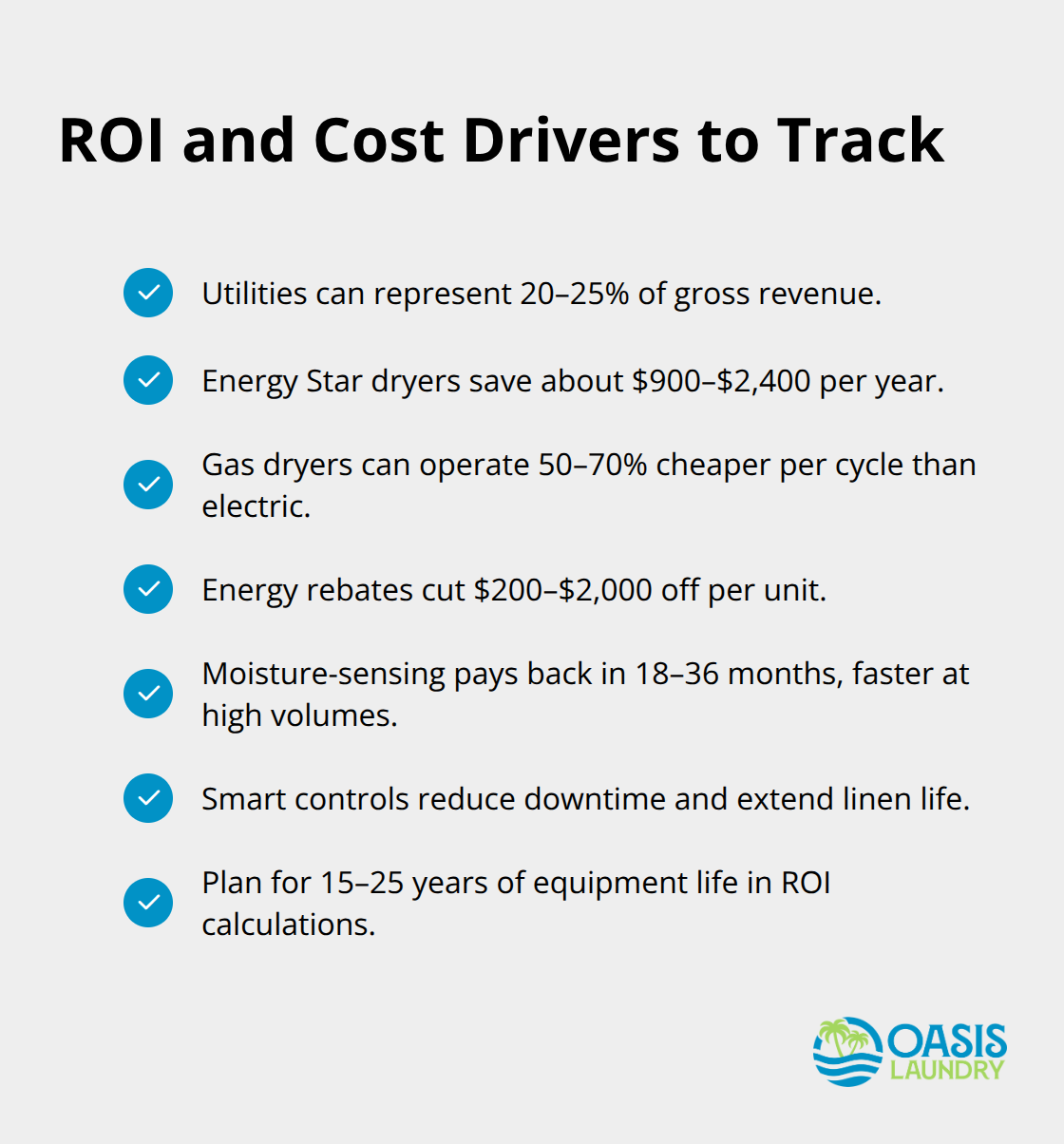
The purchase price of a commercial dryer tells you almost nothing about its true cost. Business owners often make expensive mistakes by fixating on upfront price while ignoring what happens next. Utility costs can represent up to 20-25% of gross revenue, which means an Energy Star certified dryer earning $900 to $2,400 in annual savings demolishes a cheaper unit’s advantage within months. A gas dryer costing $4,000 more than an electric model but operating 50 to 70 percent cheaper per cycle recovers that premium in roughly one year at facilities running 20 or more cycles daily.
UniMac equipment delivers up to 30 percent energy reduction compared to standard models, translating to $3,896 annually in utility savings for typical operations. Your actual payback period depends on volume, but underestimating long-term operating costs guarantees financial regret. Plan for 15 to 25 years of equipment life, meaning a dryer saving $2,000 yearly generates $30,000 to $50,000 in cumulative value beyond its purchase price.
Energy Rebates Reduce Your Real Acquisition Cost
Energy Star rebates between $200 and $2,000 per unit accelerate your return immediately. These rebates effectively reduce the real acquisition cost before you even start operating the machine. Many utility companies offer these incentives to encourage efficiency upgrades, so contact your local provider to confirm available programs. The combination of lower operating costs and upfront rebates makes higher-efficiency models financially superior to cheaper alternatives in virtually every scenario.
Maintenance Expenses Separate Reliable Operations from Constant Headaches
ProCapture lint removal technology capturing 98 percent of dryer lint reduces vent cleaning frequency, extends machine lifespan, and eliminates fire risk concerns that create liability exposure. Standard maintenance costs run roughly $500 to $1,200 annually per unit for commercial-grade equipment, while neglected machines generate emergency repairs costing $2,000 to $5,000 when components fail unexpectedly.
Moisture-sensing dryers prevent over-drying damage that shortens linen lifespan and forces premature replacement, offsetting their higher initial cost within 18 to 36 months through extended textile durability. Facilities processing 100 or more pounds daily recover moisture-sensing investments within 12 months. Smart controls with remote monitoring identify maintenance needs before failures occur, preventing the downtime that crushes profitability during peak periods.
Higher-Quality Equipment Wins Over Time
Total cost of ownership favors higher-quality equipment with proven reliability records because lower upfront price inevitably means higher maintenance bills and lost revenue from downtime. A dryer lasting 20 years with minimal repairs beats a cheaper unit needing replacement after 10 years with constant service calls. Calculate your actual scenario using realistic volume projections, then compare lease versus purchase options. Leasing improves cash flow and simplifies upgrades, while purchasing builds equity over the machine’s extended lifespan.
Final Thoughts
Selecting the right commercial laundry dryer requires you to match three core factors: your facility’s daily volume, your budget for both upfront and ongoing costs, and your operational priorities. Capacity and speed determine throughput, energy efficiency directly impacts profitability through utility savings, and smart controls reduce downtime while protecting your textile investment. Gas dryers dominate high-volume operations through superior economics and faster cycles, while electric models work for lower-volume settings where installation simplicity matters more than speed.
Your actual business needs should drive the decision, not industry trends or competitor choices. A hotel processing 100 pounds daily requires different equipment than a small salon handling 20 pounds weekly, so calculate your realistic volume and project growth at 125 to 150 percent of current capacity before sizing your dryer selection. Factor in total cost of ownership over 15 to 25 years rather than fixating on purchase price alone, since an Energy Star certified dryer saving $2,000 annually generates $30,000 to $50,000 in cumulative value beyond its initial cost.
Contact equipment providers who understand your specific operation and can recommend configurations matching your space, infrastructure, and financial goals. We at Oasis Laundry work with businesses to optimize their laundry operations through tailored solutions and expert guidance, and our team can help you explore commercial laundry dryer options that fit your situation. Start by documenting your current volume, growth projections, and available space, then reach out to qualified vendors who can provide quotes, financing options, and installation timelines for your specific needs.